
Cross Country Estates
Lots run one and a half to three acres. At that size the house sits well back off the road. The driveway is long enough to be part of the display, not just a path to it.
Dallas Center gets grouped with Waukee and Grimes because they share a county. By housing it has almost nothing in common with either one. The middle house in town was built in 1974.
Dallas County is where the metro's newest housing went up. Dallas Center is the exception, and it is not close.
is the median year a Dallas Center home was built. Waukee's median is 2011 and Grimes is 2009. Same county, thirty-seven years apart from Waukee and thirty-five from Grimes.
U.S. Census Bureau, American Community Survey 2020 to 2024 five-year estimatesof homes here were built before 1960. Only 26.4% was built in 2000 or later.
U.S. Census Bureau, American Community Survey 2020 to 2024 five-year estimateshousing units in the entire town. 79.5% of them are detached single-family, and 83.3% are owner-occupied, both near the top of the metro.
U.S. Census Bureau, American Community Survey 2020 to 2024 five-year estimatesEvery marketing page written about Dallas County in the last ten years has been about new construction. That story is true of Waukee, and it is true of Grimes. It is not true here. If somebody hands you a plan for lighting a brand new build in Dallas Center, they read the county name and stopped there.
What the numbers actually describe is a small town with old bones. A third of the housing units were up before 1960. The two shares that matter most to us are the last two: 79.5% detached single-family and 83.3% owner-occupied. Almost every roof in Dallas Center is a house, and almost everybody under it owns it. That is a better fit for this work than the newest suburbs in the county. A lot of the growth there came as townhomes and apartments.
One limit we will put on ourselves. We are not going to break that housing down decade by decade. With 969 units, the year-by-year census cells wobble more than they inform. Quoting one would be dressing up noise as a fact. The middle year and the two big shares hold up. Those are the ones we will use.
Old farmhouse in town or a house on three acres, the estimate is free either way.
Get my free satellite estimateThe city publishes its subdivisions with the acreages attached. Those numbers are the design brief.
Lots run one and a half to three acres. At that size the house sits well back off the road. The driveway is long enough to be part of the display, not just a path to it.
52 country lots arranged around a ten-acre neighborhood lake. Water in the middle of a neighborhood means half the houses are seen across it at night. That is further away than the owners think.
67 acres, and every home in it has geothermal heating. That is the city's own description of it.
On a tract street in Waukee, the reference point is the house next door. Yours is fifteen feet away and lit the same way, so the eye reads small differences. Spacing, bulb color, whether the porch got done.
On an acre and a half, there is no house next door to read against. The reference point is the road. You are seen from two hundred feet away, and from an angle. Usually through trees. Usually while somebody drives past at thirty-five. That changes three things about how we lay a house out.
The run has to be unbroken. At that distance the eye does not see a bulb, it sees a line. A gap where a run stopped short of a gable is invisible up close and obvious from the road. That is the whole argument for cutting every run to the real roofline. The other option is a fixed store length and a gap you live with.
The trees are worth more here. On these lots the trees stand alone in open ground, not in a row along a curb. One wrapped trunk between the road and the house does more work here than the same wrap does on a tight lot. Nothing else is in the frame with it.
The driveway is the approach. A three-acre lot has a long one. Whatever the eye follows on the way in does as much work as the roofline. It is the piece almost nobody plans for.
Send the address. Satellite imagery reads a long lot just fine.
Get my free satellite estimateWe wrote pages for eleven towns. This one gets the honest version, because there is no way to write it otherwise.
Dallas Center has zero buildings on the National Register of Historic Places. There is no historic district. There is no judged decorating contest, no lighted parade, and no street that the rest of the metro drives out to see.
Other towns we serve do have those. Adel runs a paid tour of decorated historic homes. Windsor Heights runs a judged contest that about one home in twenty enters. Ankeny has a street that has done the same display for thirty-one years. Dallas Center has none of that, and we are not going to invent a tradition to fill the space.
What it has instead is 969 housing units, a park with a gazebo, and one Saturday in December. If your reason for lighting the house is that you want to win something, this is the wrong town for it. If your reason is that you want the place to look good from the road, we can work with that.
Dallas Center has exactly one registered homeowner association, at Country Living Estates, formed in 2004. Adel has eighteen.
That is the practical difference between the two towns. In most of Dallas Center there is nobody to ask. What you hang on your own house is your call.
We can tell you the count, because associations are on the public record. We cannot tell you what that one allows. It does not publish its covenants, and neither does almost any other in this metro.
One thing we did confirm: no city in this metro has an ordinance on holiday decorations, seasonal lighting, or when lights have to come down. Dallas Center included. That question comes up a lot and the answer is that there is no rule.
No appointment, nobody at your door, and no follow-up if you say no.
Get my free satellite estimate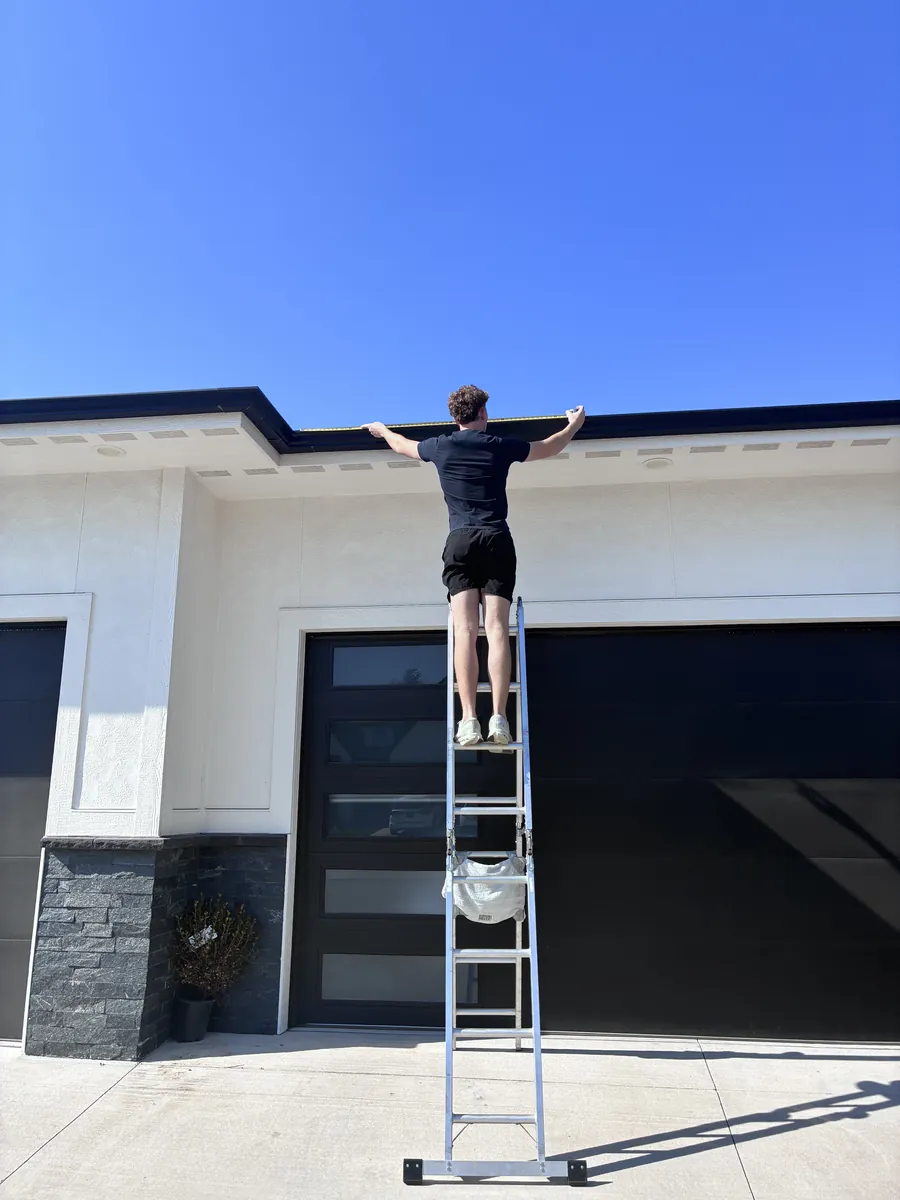
Commercial-grade C9 bulbs, cut to fit the roofline they are on.
The city puts the DC Hometown Christmas Celebration on its own events page for the first Saturday in December. Tree lighting, cookie decorating, ornament making, and Santa. It happens at Mound Park, 601 Percival Ave, which the city's own page calls "the hub of Dallas Center hosting many community events throughout the year." The park has a gazebo you can reserve through City Hall.
That single Saturday is the deadline that matters here. Whichever houses are lit that evening are the ones people talk about.
Installs run from mid-October. To be lit for that Saturday, be booked by the week before Thanksgiving. Here is the full calendar.
City of Dallas Center, community events and parks pages969 housing units is small. Take out the attached and the rented, and roughly six hundred and fifty houses are left. Those are the ones this work is aimed at. We would rather put that number on the page than pretend Dallas Center is a bigger market than it is.
It cuts both ways, and the good side is real. A small town is a short route. On a short route, the day a bulb goes out is a day somebody is already nearby. Tate is the one on the roof and the one who answers the text. That is easier to keep true in a town of 969 housing units than in a town of twelve thousand.
Go deeper: what drives the price • what we install • when to book • doing it yourself • storage and takedown • get in touch
Send the address. Tate pulls satellite imagery of your roofline, measures the runs, counts the peaks, and texts a ballpark back. Usually the same day. No appointment, and nobody comes to the house for this part.
Two fields. Tate reads your roofline off satellite imagery and texts a ballpark back, usually the same day.
Rather talk first? Call or text 515-585-9079